
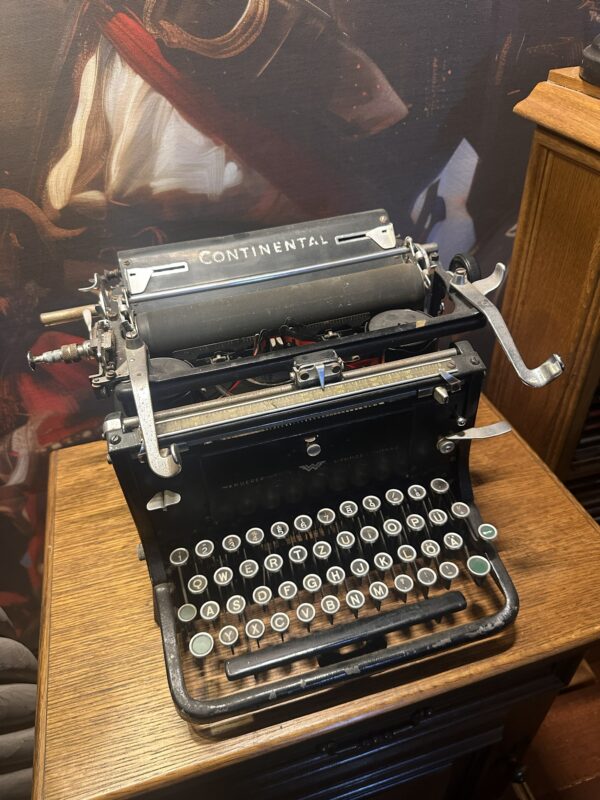

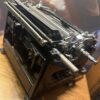
Original Continental Standard mechanical typewriter, manufactured in Germany by Wanderer-Werke of Siegmar-Schönau.
The Continental Standard is one of the historically important German office typewriters. Wanderer-Werke began serial typewriter production under the Continental name in 1903, with the Continental Standard reaching the market in 1904. According to the Industriemuseum Chemnitz, the design was protected by approximately 60 patents, remained largely technically unchanged for almost four decades and became the highest-selling German typewriter of its period.
This example belongs to the classic pre-war generation of Continental Standard machines. Comparable surviving machines carrying the same Wanderer-Werke Siegmar-Schönau identification are documented from the 1930s, including a serial-numbered example manufactured in 1938. Without checking the serial number of this individual machine, a precise production year cannot be guaranteed.
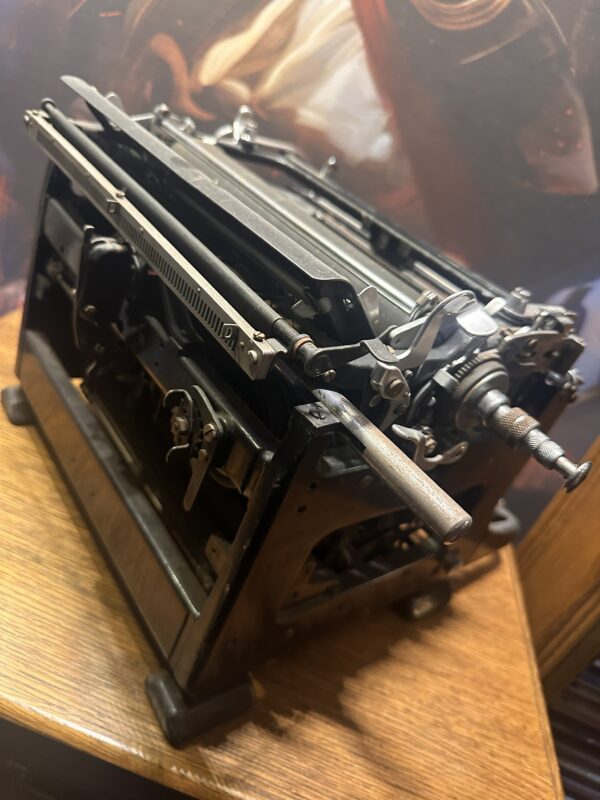
It is a substantial full-size desktop office machine with a heavy black-painted metal construction, exposed mechanical typebar assembly and the characteristic open-frame architecture associated with the Continental Standard.
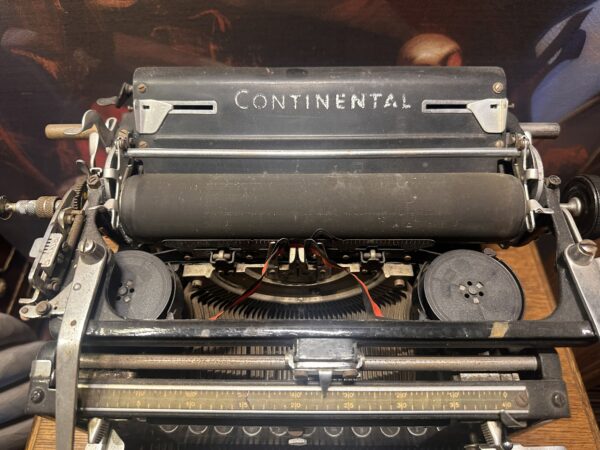
The machine is equipped with an original-style German QWERTZ keyboard, including German characters Ä, Ö and Ü, round character keys, large space bar, mechanical shift controls, full carriage and platen assembly, carriage-return mechanism, paper scale and guides, margin controls, twin ribbon spools and an installed black/red ribbon.
The front carries the Wanderer-Werke / Siegmar-Schönau manufacturer’s identification, while CONTINENTAL is prominently marked across the upper rear section.
The Continental Standard was built as a professional office machine rather than a lightweight portable typewriter. Its substantial construction, exposed mechanical engineering and strong connection with German industrial history make surviving examples attractive to collectors of early office technology and mechanical equipment.
This example remains in unrestored vintage condition. It has accumulated dust and surface dirt, particularly around the internal mechanism, platen and ribbon assembly. The black finish has scratches, chips and areas of wear, while exposed metal components have age-related tarnishing, discoloration and some oxidation. The Continental lettering is worn but remains identifiable.
The principal components are present, including the keyboard, carriage, platen, typebar assembly, ribbon spools, carriage controls and mechanical operating components. An old black/red ribbon remains installed and should be regarded as requiring replacement.
The machine is untested, and no guarantee of mechanical operation is given. Considering its age and unrestored condition, cleaning, lubrication, adjustment and servicing should be expected before regular typing use.
A substantial and authentic piece of German industrial history, suitable for a typewriter collection, restoration project, historical office display, vintage interior, museum-style collection, theatre or film production, or mechanical-technology collection.
Reviews
There are no reviews yet.